Atomic Habits Summary: 4 Laws to Make Tiny Changes Stick & Compound
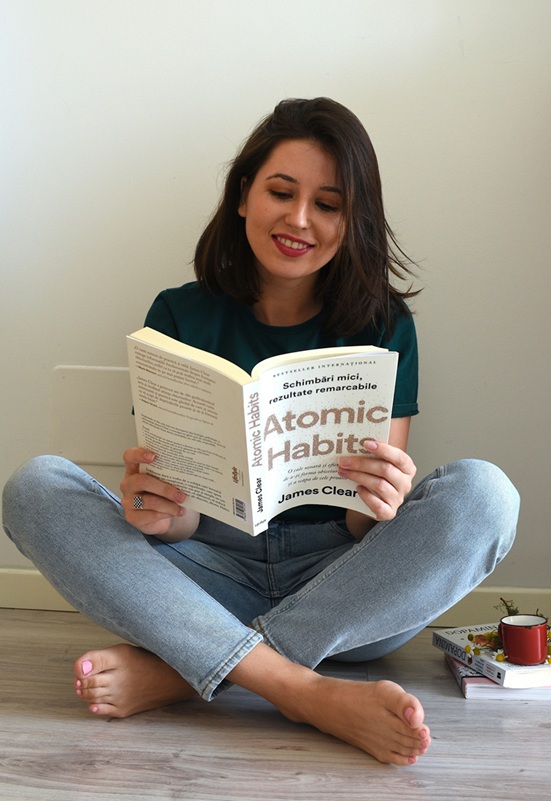
For the longest time, I believed that transformation required massive action — a dramatic overhaul, a bold leap, a life-changing decision made in a single moment. Then I read Atomic Habits by James Clear, and it quietly dismantled everything I thought I knew about change. What I found instead was something far more powerful, and honestly, far more hopeful: the idea that the tiniest shifts, practiced consistently, are what actually move the needle.
This book is one of those rare reads that stays with you long after you've closed it. Not because it's full of grand revelations, but because it explains — with beautiful clarity — why we are the way we are, and exactly how to become the person we want to be. Below, I'm sharing the key insights that hit me hardest, and how they connect to the manifestation work we explore together here at Celes Circle.
You do not rise to the level of your goals. You fall to the level of your systems.
— James Clear, Atomic Habits
Watch the video version — save it for later ✨
What is the main idea of Atomic Habits?
Atomic Habits is built on one deceptively simple premise: small habits, compounded over time, produce extraordinary results. James Clear calls this the aggregation of marginal gains. If you improve by just 1% each day for a year, you end up 37 times better than when you started. And if you decline by 1% each day? You drift down to nearly zero. The direction of your daily habits matters far more than any single decision you'll ever make.
But this book isn't just about discipline and willpower — it's about understanding the invisible architecture of behavior. Why do we keep doing things that don't serve us? Why is it so hard to start the habits we actually want? Clear answers these questions with science, stories, and a deeply practical framework that anyone can use.
Every action you take is a vote for the type of person you wish to become.
— James Clear, Atomic Habits
Identity is the foundation of lasting change
This is the insight that stopped me in my tracks. Most of us approach habits from the outside in: we set a goal (lose 10 pounds, write a book, meditate daily) and then try to work our way backward to the behavior. James Clear flips this completely. He argues that the most durable habits come from the inside out — from a shift in identity.
Instead of saying "I want to run a marathon," you start telling yourself "I am a runner." Instead of "I want to read more," it becomes "I am someone who reads every day." That small reframe changes everything, because your habits become an expression of who you are, not a means to an end. And every time you act in alignment with that identity — even in a tiny way — you cast a vote for that version of yourself.
This principle resonates so deeply with manifestation. When we do the inner work of deciding who we are becoming, our outer habits naturally start to align. You stop forcing yourself and start flowing toward what feels true.
The Plateau of Latent Potential
One of the most comforting ideas in this entire book is the concept Clear calls the Plateau of Latent Potential. He describes it with a beautiful image: an ice cube sitting in a cold room. The temperature slowly rises — 25°F, 27°F, 29°F — and nothing seems to happen. The ice just sits there. Then the temperature hits 32°F, and suddenly it melts.
That single degree wasn't more important than the others. Every degree mattered. But the results only became visible at the tipping point. This is exactly what happens with habits. You meditate for three weeks and feel like nothing is changing. You journal every morning for a month and wonder if it's even working. And then one day, something shifts. The calm is just there. The clarity is just there.
The work was never wasted. It was accumulating beneath the surface, waiting for the moment it could break through. Don't give up before the ice melts.
Breakthrough moments are often the result of many previous actions which build up the potential required to unleash a major change.
— James Clear, Atomic Habits
The four laws of behavior change
At the heart of Atomic Habits is a framework for building good habits — and breaking bad ones. Clear distills all behavior into a simple four-step loop: cue, craving, response, reward. From this loop, he derives four laws. Master these, and you can architect virtually any habit you want.
-
Make it obvious (the cue)
Habits start with a trigger — a cue in your environment that initiates the behavior. The problem is that most of our cues are invisible to us; we act on autopilot without realizing it. To build a new habit, you need to make the cue impossible to miss. Two powerful techniques: implementation intentions (deciding exactly when and where you'll do the habit — "I will meditate at 7am in my bedroom") and habit stacking (attaching the new habit to an existing one — "After I pour my morning coffee, I will write three intentions for the day"). Design your environment so the right cues are everywhere.
-
Make it attractive (the craving)
We repeat what we anticipate will feel good. So the more appealing a habit feels, the more motivated we are to actually do it. Clear introduces temptation bundling — pairing a habit you need to do with something you genuinely enjoy. Only listen to your favorite podcast while you're on your morning walk. Only light your favorite candle during your journaling practice. When the habit starts to feel like a treat, resistance dissolves. You can also lean into your community here — surrounding yourself with people who already embody the habits you want makes those habits feel normal, even desirable.
-
Make it easy (the response)
The biggest enemy of good habits is friction. The harder something is to start, the less likely we are to do it. Clear's solution is to reduce friction to almost nothing — and his most famous tool for this is the Two-Minute Rule: scale any habit down until it takes two minutes or less. "Practice yoga" becomes "lay out my yoga mat." "Read before bed" becomes "open my book." The goal isn't the two-minute version — it's using it as an on-ramp. Once you've started, momentum carries you forward. Master the art of showing up, and the rest takes care of itself.
-
Make it satisfying (the reward)
What gets rewarded gets repeated. Our brains are wired to prioritize immediate pleasure over delayed gratification — which is why good habits (whose rewards often come weeks or months later) are so hard to maintain. The trick is to add a small, immediate reward to the habit loop. Track your habit on a simple calendar and cross off each day — the visual proof of your streak becomes its own reward. Never miss twice: one missed day is an accident, two is the start of a new (bad) habit. Give yourself something to feel good about in the moment, and your brain will start craving the habit itself.
Your environment is your most powerful habit tool
James Clear makes a point I return to again and again: we don't live in a vacuum — we live in an environment. And our environment is constantly shaping our behavior, whether we're aware of it or not. The good news is that we can design our environment intentionally.
Want to drink more water? Put a glass on your desk. Want to read more? Leave your book on your pillow. Want to eat healthier? Make the fruit visible and put the junk food out of sight. And for breaking bad habits, it works in reverse — add friction. Delete the app. Move the TV out of the bedroom. Put distance between yourself and the trigger.
This feels deeply aligned with what we know about energy and space in spiritual traditions. Your physical environment is an extension of your subconscious. When you clear, organize, and intentionally design your space, you're sending a message to yourself about who you are and how you want to live. Environment design is, in its own way, a form of sacred space-making.
Why atomic habits supercharge your manifestation
1. Your habits are votes for your identity — and your identity shapes what you manifest
In manifestation, we talk a lot about becoming the version of yourself who has already received what you're calling in. Atomic habits give you a practical, daily way to do exactly that. Every small habit you build is a vote for a new identity. Stack enough votes, and the belief shifts from "I want this" to "this is who I am." And when your identity aligns with your vision, manifestation stops feeling like a reach — it starts feeling like an inevitability.
2. Consistent small actions are the bridge between vision and reality
Manifestation is not passive. It requires you to be a vibrational match — and that means taking aligned action. The beautiful thing about atomic habits is that even the smallest action counts. A two-minute meditation. A single page of your journal. One deep breath before a difficult conversation. These micro-actions keep you in motion, in alignment, and in communication with the Universe. They say: I am serious about this life I'm building.
Aligned actions don't have to be grand. They just have to be consistent.
3. The Plateau of Latent Potential protects your faith
One of the hardest parts of any manifestation journey is the waiting — the in-between period when you've done the work but the results aren't visible yet. The Plateau of Latent Potential is a reminder that invisible progress is still progress. Your energy is shifting. Your neural pathways are rewiring. The ice is warming. Trust the process, keep showing up, and know that the breakthrough is coming — it's just waiting for the right moment to reveal itself.
Atomic Habits Workbook & Summary PDF
Ready to start building habits that actually stick? This free workbook walks you through the book's key insights and gives you practical worksheets to design your own Four Laws habit system.
A final thought
What moves me most about Atomic Habits is the grace it offers. You don't need to overhaul your entire life overnight. You don't need to be perfect. You just need to be 1% better today than you were yesterday — and to trust that those tiny, faithful steps are building something extraordinary beneath the surface.
That is a deeply spiritual idea, even if James Clear doesn't frame it that way. Every day, we are either becoming more of who we want to be, or drifting further from it. Our habits are the daily practice of that becoming. And when we align them with our soul's vision, they become one of the most powerful manifestation tools we have.
If this resonated with you, I highly recommend picking up the book — and pairing it with the intentional practices we share here at Celes Circle. Your dream life isn't built in a single leap. It's built one tiny, beautiful habit at a time.